Education Means Power!
 |
| Mrs. Belinda K. Grant, Executive Director of Mt. Zion Community Development (MZCD). |
“Project EMPOWER” Helps Teens
Project Empower is providing teens with the tools they need to stay in school-and avoid pregnancy.
By Cathy Holt
Mrs. Belinda K. Grant, Executive Director of Mount Zion Community Development (MZCD), is very proud of the program, which began with a four-year grant in 2003. The program currently serves 40 teens, male and female, ages 12-17, in four age-based groups. Its goals? To reduce teen pregnancy and to reduce school dropout rates. The minority teen pregnancy rate (ages 15-19) in Buncombe County in 2002 was twice that of the white population.
Meeting Teens Where They Are
Whose teens are
at risk of becoming pregnant or dropping out of school? According to
Grant, ALL teen girls are at risk for pregnancy, and ALL teen males are
at risk of impregnating a teen, but some known antecedents of teen
pregnancy are: minority populations, teens living at or below the
poverty level, single parent family, low income, poor academic
achievement, and truancy.
Statistical data
from Mission Hospitals (2005) reports the following for teenage births
ages 14-19 in the designated zip codes of: 28801 (17), 28803 (23),
28804 (11), 28805 (15), and 28806 (61).
Project EMPOWER
utilizes the national “TOP” (Teen Outreach Program), a structured
curriculum proven to reduce teen dropout rates by 60%, teen pregnancy
by 33%, school suspensions by 14%, and school course failures by 11%.
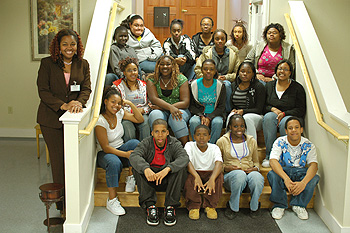 |
| From the top row to the bottom row, left to right: Row One: Diamond Dones, Rita Bomar, Startricia Bethea, and Storm Pertiller. Row Two: Sohna Njie, Brit’nee Littlejohn, and Jeanisha Williams. Row Three: Karima Hemphill, Crystal Sherriff, Tamela Collins, Jasmyne White, and Sequoia Howard. Row Four: Nakia Harrell. Row Five: Kelvin Gibbs, Thomas O’ Hannon, Zequoia Jordan and Darius Burton. |
Program
components of TOP are community service, classroom-based instruction
and service learning. Program participants are selected through
Asheville City Schools’ referrals, and through community outreach and
collaboration. Our students meet during and after school hours with
parental permission as a requirement.
The Asheville
City School System personnel, along with Asheville Parks &
Recreation, provide the sites. Both are major advocates of this
program. Project EMPOWER staff meets with students one hour per week to
implement the TOP curriculum. Participants are all African-American at
this time. Parental permission is a requirement
“Our program is
abstinence-based,” says Mrs. Grant. “Although some teens may already be
sexually active, we provide an educational component, teaching them
about consequences of pregnancy. There is also goal setting; service
learning, and a community service component which entails completing 20
hours per year of community service. This means volunteering services
with local programs and/or agencies, thereby learning to give back to
the community. Group discussions offer participants opportunities to
enhance their personal development, their value system, relationships
with their parents and their peers.
We employ
community partners such as the Buncombe County Health Center, Planned
Parenthood, and WNCAP to discuss sexuality issues/ sex education. We
believe in a holistic approach, meeting teens where they are, so an
initial psycho-social assessment is completed upon enrollment, to
ascertain family background, academic information, socio-economic
information, mental status, and other pertinent data to more
effectively coordinate services.”
Teens Speak Out
In 2002, in
preparation for the program, a Listening Project with teens was
conducted. The older teens said things like, “It’s too late for us to
be educated-you should have reached us earlier, before we became
sexually active.” Some teens in the Listening Groups stated that they
had gotten pregnant intentionally, because “I wanted to feel loved,” or
“I wanted somebody to love.” Some said, “I knew that babies would cry,”
but they had no idea of the financial and emotional burdens. Said one:
“I don’t need another lecture on the birds & bees. It would catch
my attention if someone came in with AIDS and said, ‘This is what I go
through every day…’”
As a result of
this input, says Grant, “We’re setting up having teen moms come in and
talk to the students about struggles they may encounter on a daily
basis. Students have been heard to say, ‘Girl, when I want to go to the
mall, I just get myself ready. If I had a baby, I would have to pack up
all the diapers and toys and snacks and milk and get the baby cleaned
up, and then be too tired to go!’
Role-Playing and Goal Setting
Each participant
completes an empowerment plan. “Name three strengths, things you feel
good about. Name three areas for growth.” From that, they formulate
their own empowerment plan, writing three realistic goals they hope to
accomplish in the year. Through partnerships with area organizations
like the Delta House, students receive tutoring to improve their
academic status.
One component
that is really important in working with teens is establishing rapport
and trust in working with the students. Letitia Bromell, Project
EMPOWER’s Outreach Worker, is dedicated to providing quality services
and worthwhile activities for the students. She has a great
relationship with the young people.
Mrs. Grant
relates: “Several young ladies enrolled in the program have agreed to
be abstinent as they are learning to love themselves first, and to care
for their own future. Many of the girls realize that their boyfriends
may not be around if they get pregnant. The boys say, ‘If you love me
you will…’ and we ask the girls to say, ‘If you love me, WE WON’T.’
We do role playing. I can act like a guy who’s in love, really
pressuring the girls! We have fun!”
In addition to
group activities, there is also a monthly individual contact with each
student to enhance trust and relationship building. If a crisis
develops, participants and their families are referred to appropriate
community resources.
“Through a
series of curriculum-guided instruction and day-to-day relationships
with the teens, we instill hope and goal setting, and encourage
students to aim for college,” says Mrs. Grant. “We tell them, ‘You can
be anything you want to be.’ On a recent trip, I heard a young lady
say, ‘I am going to college, then I’ll get married, and then have two
children…’ She had it all laid out, in that order! We know we are
making a difference.”
Project Empower
works closely with the Asheville City School system and the parents.
Parental approval is necessary for a student to join the program, and
parental involvement is important. State and local policies restrict
how much sex education can be done in the schools. What frees Project
EMPOWER to implement the TOP Curriculum, is parental permission.
The 12-14 year
old participants will attend a day trip to a local college or
university. The 15-17 year old participants are eligible for an
overnight College Tour. Last year five students went on an overnight
college tour. This year the tour, which occurs March 29-31, will
include NC State, NC Central, Duke, Wake Forest University, and Winston
Salem State University.
Each month,
students have the opportunity to take part in a cultural experience;
last month many students went to the Broadway play, “Cats.” The
Asheville Arts Council makes this possible, by providing in-kind
donation every month. Students have attended ballets, jazz concerts,
and plays. Students must attend class on a regular basis and complete
their 20-hour community service requirement to go on a year-end trip to
Carowinds, an all-day trip with dinner out afterwards. Students receive
incentives like afternoon snacks, gift certificates, and parties, to
make sure they attend classes and do the service requirement.
“Every teen
needs structure and boundaries,” says Grant, who was a social work
supervisor at Buncombe County Health Department for nearly ten years.
Although working with teens can be challenging, Grant states she loves
what she does, and the dividends are definitely rewarding. All teens
struggle with life changes. “It could be my child, struggling with
these issues,” she says. “I see my role as a calling—to empower
individuals and their families to reach their goals and obtain services
they deserve.”
Empowerment Gets Results
One of their
students who graduated Asheville High last year was in Who’s Who of
American Students, and is now in her freshman year at Western Carolina
University. “She received the first scholarship in the amount of
$1,000.00,” Mrs. Grant reported. “We partner with local organizations
to secure scholarships and other services for our students and ask,
‘What can we do to serve you?’ So it’s not just being on the receiving
end, it is reciprocal.” Dr. & Mrs. John H. Grant received an
‘Honoring the Spirit of the Family’ award in January 2004 from Gamma
Gamma Omega Chapter of the Alpha Kappa Alpha Sorority for exemplary
service provided to families in Buncombe County.
Project EMPOWER
is a grant-funded program. In 2004, Project EMPOWER was also awarded a
$5000 grant from Wachovia Bank for this program. Grant stated this
grant award strengthened the program’s ability to successfully
implement the scope of services for teen development.
In the first
three years, only one teen became pregnant out of 114 students; no
students have dropped out of school. Grant hastened to add that this
student was referred to appropriate resources for support.
The program’s
Advisory Committee members include: Anna Tillman, Buncombe County
Health Center; Ben Ambrosino, Mountain Area Child & Family; Latessa
Johnson and Doug Jones, Asheville City Schools; Emmaleigh Argonauta,
WNC AIDS Project; Nanci Farmer, Mayor’s Office; Linda Hemstreet,
Mission St. Joseph’s Women’s Resource Center; Sara Green, Buncombe
County Health Center; and Tangie Ballard, YWCA.
To contact Project EMPOWER or Belinda K. Grant, please call:
(828) 775-5686, or Letitia Bromell at (828) 776-1429.