Celebrating Citizenship: Participatory Democracy
 |
By Moe White
The aspiration to freedom has motivated people from nations around the world to leave their homelands and settle here, just as it motivated 19th century slaves and abolitionists to end slavery and progressives in the 20th century to fight Jim Crow laws and push for full civil rights for African Americans. The same aspirations have pushed Native Americans to demand their rights, both as national peoples and under treaties, and have impelled millions of our southern neighbors to cross our borders illegally to make a new life here.
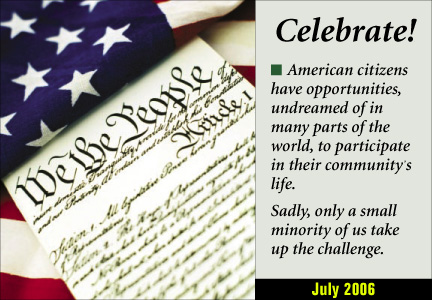
American citizens, whether by birthright or naturalization, under the protection of civil rights laws or despite broken treaties and other hurdles, have opportunities undreamed of in many parts of the world to participate in their community\’s life. Sadly, only a few of us take up the challenge and take on the responsibility of doing so.
But democracy, to work, relies on the participation of its citizens — the word itself means “government by people.” And those people are not just the names you see in the news, like City Council members — they\’re your neighbors, friends, relatives, business owners and others in the community. In other words, government by people means people like you.
How many really participate? The United States has one of the lowest voting rates of any developed democracy, with scarcely half the eligible citizens bothering to vote in national elections and as few as ten percent showing up at the polls in other years. Even among citizens who take the trouble to register and then cast their ballots, there are few who participate actively in the life of their community beyond Election Day.
Yet American cities and towns are among the few places in the world where anyone can have a real, direct, and measurable influence on the place we live. In addition to elective offices that are, theoretically, available to anyone who wishes to run, there are appointed seats on public boards and commissions that affect everything from our schools, streets, parks, development, to all sorts of social and cultural issues. Most of these appointments are unpaid, but they don\’t demand an unreasonable commitment of time and effort. Public boards and commissions generally meet once a month or once every other month, usually for one or two hours at most. That\’s less time than many of us put in serving on committees for our places of worship or even in helping arrange block parties, attending school meetings, or other activities.
Minority communities are especially underrepresented in civic life. Look at the city\’s and county\’s boards and commissions, or even at the boards of directors of private nonprofit organizations, and you see the names of very few, if any, African Americans, Hispanics, Ukrainians, Cherokee, or other nonwhite individuals.
Some might assume that bias is to blame, but that\’s unlikely, certainly in appointments by a city council headed by an African American mayor. A more pertinent reason is that few members of minority communities put their names in for consideration for appointment. Even a group in favor of affirmative action (or even quotas) is hard put to choose a nonwhite board member if every applicant is white.
Several times each year the city of
It\’s your democracy, your “government by people.” But it works for you only if you are willing to work for it. Demonstrate your commitment to your community, so the people who make appointment decisions know who you are and what you stand for. Talk with your neighbors and friends, contact your elected officials, attend meetings of the boards and commissions that interest you, learn how they operate and what they do, and volunteer to help.
The more we all participate, the more we have to celebrate.
Community Action Opportunities (formerly Opportunity Corporation of
Community & Economic Development
Planning and Zoning Commission. The commission is an advisory board to City Council. Residents of every community from Shiloh to
Education Access Channel Commission. This Commission will oversee the management and programming of the Education Access Channel and will work with the education community to achieve this task. One of three public channels provided by Charter Communications under its franchise agreement with the city of
If you need more information or just want to discuss participating on a board with a City Council member, call the City Clerk\’s Office at 259-5601 for a Council member\’s phone number or for an application to apply.