Women on a Global Mission
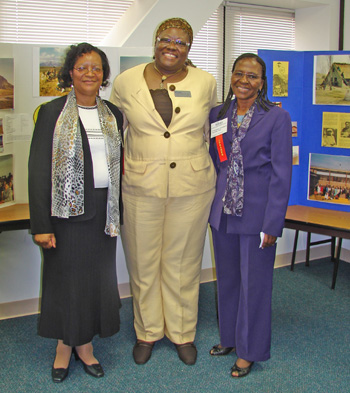 |
| From left to right: Maureen M. Phoya, R.N., Ph.D, Jaqueline Hallum, MPH – Director of Health Careers and Diversity Management, and Ambassador Molelekeng Rapolaki. Photo: Urban News |
Staff reports
Ambassador Rapolaki and Dr. Maureen Phoya visit Asheville.
Mountain Area Health Education Center (MAHEC), was host to Ambassador Molelekeng Rapolaki and Maureen M. Phoya, R.N., Ph.D, who lectured on the health parity mission of Southern African Development Community (SADC) of South Africa.
While HIV/AIDS is of paramount concern for both these women, the SADC vision is one of a common future within a regional community that will ensure economic well-being of its people. Their mission also focuses on achieving improvement in the standards of living, quality of life, freedom and social justice, and peace and security for the peoples of Southern Africa.
Ambassador Molelekeng Rapolaki, MPA is a visiting Diplomat-in-Residence at Winston-Salem State University’s School of Health Sciences where she assists the school and the university to develop links and partnerships with African countries, universities, government agencies, non-governmental organization and civil societies.
Prior to her engagement with WSSU, she served as Ambassador of her
country, Lesotho, to the United States for six years. During this
period she focused on trade, health and education as her ambassadorial
platform to promote Lesotho’s interests in the U.S. She became one of
the prominent African ambassadors to lobby U.S. Congress for extension
of the Africa Growth Opportunities Acts (AGOA) to 2015, qualifying
African countries to export some goods to the U.S. duty-free. She
successfully secured financial support from the U.S. Global Fund for
HIV/AIDS program when her country was not chosen as one of the PEPFAR
countries.
She is a graduate of the University of Southern California, where she
attained an MPA with specialization in Population Policy in 1993. She
holds and Undergraduate Degree in Economics (1980) from the National
University of Lesotho.
Ann M. Phoya, R.N., PhD., realized her dream of becoming a nurse in
1977 when she received her diploma in nursing and midwifery from the
National School of Nursing in Blantyre, Malawi, Africa. She continued
her education and received her BSN from the Medical University of
Southern Africa in Pretoria, with a specialty in public health, nursing
administration, and midwifery education.
During the past 32 years, Dr. Phoya has worked in various health care
settings in Africa and the United States. She has held positions as
head nurse, instructor, lecturer, and department head of community
health nursing, program manager and Chief Nursing Officer for Malawi.
Currently, Dr. Phoya serves as Director for the Health Sector Reform
Program for the Ministry of Health in Malawi, Africa.
She is on leave from this position while serving as a Fulbright
Scholar-in-Residence at Winston-Salem State University’s Department of
Nursing.
The Southern African Development Community (SADC) has been in existence
since 1980, when it was formed as a loose alliance of nine
majority-ruled states in Southern Africa known as the Southern African
Development Coordination Conference (SADCC), with the main aim of
coordinating development projects in order to lessen economic
dependence on the then apartheid South Africa. The founding member
states are: Angola, Botswana, Lesotho, Malawi, Mozambique, Swaziland,
United Republic of Tanzania, Zambia, and Zimbabwe.